Flipping means buying an item on the Grand Exchange and selling it again for more a short time later. You are not betting that the price will rise. You earn the gap between what impatient sellers accept and what impatient buyers pay.
This guide covers the whole method. You will learn how to find a real margin, how to work out what the 2% tax leaves you, and how buy limits cap each 4-hour window. It also covers why volume matters more than a big margin and how game updates can catch you out. The live margins table further down the page uses the same terms, so you can read it once you have finished the guide.
How a Grand Exchange flip works
Every actively traded item has two prices at any moment:
- The instant-buy price is the price players pay when they want the item right away. It is the high end.
- The instant-sell price is the price players accept when they want coins right away. It is the low end.
An offer fills when a buy price meets or beats a sell price. The trade happens at the price of the offer that was already waiting. A buyer who overbids gets the extra coins back, and a seller who underbids is paid the higher waiting price.
A flipper places a buy offer near the low end and waits for sellers to fill it. They then place a sell offer near the high end and wait for buyers. Profit is the gap between the two prices, minus tax, for every unit that fills.
Holding an item for days or weeks because you expect its price to move is a different activity, usually called investing. It carries more risk. Flipping finishes within hours and does not need the price to move at all.
Check the margin before you buy
A margin check shows you the real gap right now. Do it before you put serious money into an item:
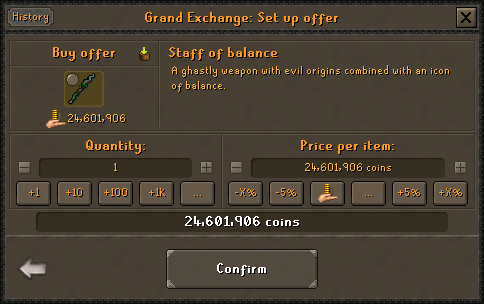
- Place a buy offer for one unit well above the going price. It fills at once, at the lowest price a seller is currently asking. That price is your sell target.
- Sell that unit well below the going price. It fills at once, at the highest price a buyer is currently offering. That price is your buy target.
- Take the tax off the sell target (see the next section). If what remains per item is not worth your time, skip the item.
- If it is worth it, place your real offers just inside the gap: a coin or a few above the buy target, and a little below the sell target. Offers there tend to fill ahead of others at the same edge.
- Give the buy offer a deadline. If it has not filled by then, the gap has probably moved, so cancel it and check again.
The check costs you the tax on one sale plus any loss on that one unit. That is cheap information for an item you plan to buy in the thousands.
The guide price shown in game is not the margin either. It is an average of past trades. Since 30 September 2026 it updates every 3 hours and can move up to 20% at a time, but it still says nothing about the gap between buyers and sellers right now.
The 2% GE tax and what it does to your margin
When you sell an item on the Grand Exchange, 2% of the sale price is taken from what you receive. The rate was raised from 1% to 2% on 29 May 2025. Three details matter for flipping:
- It rounds down. An item that sells for under 50 coins pays no tax at all.
- It is capped at 5,000,000 coins per item. The cap applies from a sale price of 250,000,000 upward. At 1,000,000,000 the tax is still 5M, which is 0.5% of the price.
- Some items are exempt, including the Old school bond at any price (full list below).
Your profit on each item is:
Sell price − tax on the sell price − buy price
| Example (not live prices) | Buy | Sell | Tax | Profit per item |
|---|---|---|---|---|
| Cheap bulk item | 40 | 48 | 0 | 8 |
| Mid-price item | 1,000 | 1,060 | 21 | 39 |
| Thin margin | 500,000 | 510,000 | 10,200 | −200 |
| Above the cap | 300,000,000 | 306,000,000 | 5,000,000 | 1,000,000 |
The third row is the trap. A 10,000 gp gap looks like profit, but the tax is larger than the gap. Below the cap, the sell price has to be a little more than 2% above your buy price before you make a single coin. As a quick check, multiply your buy price by 1.021. If the sell price is not above that, the flip loses money or barely breaks even.
The round-number trick
Because the tax rounds down, a price that is an exact multiple of 50 pays you the same as one coin less. Selling at 1,000 pays 20 tax and leaves you 980. Selling at 999 pays 19 tax and also leaves you 980. If the lowest sell offer sits on a multiple of 50, undercutting it by one coin costs you nothing.
Items that pay no tax
These exemptions matter most to flippers:
| Item | Why it matters |
|---|---|
 Old school bond | Untaxed at any price, so the whole gap is yours |
 Energy potion | A common consumable with no tax |
 Mind rune | The only exempt rune |
 Games necklace(8) | Untaxed; only the full-charge (8) version can be traded on the GE |
 Ring of dueling(8) | Untaxed; only the full-charge (8) version can be traded on the GE |
The rest of the exempt list is cheap gear and supplies:
- Ammunition: Bronze arrow, Iron arrow, Steel arrow, Bronze dart, Iron dart and Steel dart.
- Food: Bass, Bread, Cake, Cooked chicken, Cooked meat, Herring, Lobster, Mackerel, Meat pie, Pike, Salmon, Shrimps and Tuna.
- Teleports: the Ardougne, Camelot, Civitas illa fortis, Falador, Kourend castle, Lumbridge, Varrock and Teleport to house tablets.
- Tools: Chisel, Gardening trowel, Glassblowing pipe, Hammer, Needle, Pestle and mortar, Rake, Saw, Secateurs, Seed dibber, Shears, Spade and Watering can.
Buy limits and the 4-hour window
Most items have a buy limit: the most you can buy within a 4-hour window. The window works like this:
- The timer starts when your first unit is bought, not when you place the offer.
- Exactly 4 hours later the limit resets in full, however your other purchases were spread across that time.
- Selling has no limit.
- Some items share one limit. If you reach the limit on Prayer potion(4), for example, you cannot buy lower-dose Prayer potions either.
- Item sets have their own limits. Most armour sets are capped at 8.
The buy limit, not the size of your bank, sets the most one item can earn you per window:
Profit per item after tax × units bought and sold = profit per 4-hour window
| Two made-up items | Profit per item | Buy limit | Profit per window |
|---|---|---|---|
| Bought at 1,000, sold at 1,060 | 39 | 10,000 | 390,000 |
| Bought at 2,000,000, sold at 2,050,000 | 9,000 | 8 | 72,000 |
The cheap item earns more than five times as much per window, from a margin per item that is about 230 times smaller. That is why flippers rank items by profit per window, not by margin per item.
Once you can afford an item's full limit, extra coins do nothing for that item until the window resets. To put more money to work, flip more items at the same time.
Volume beats margin: pick items that actually trade
A margin only pays if your offers fill. An item with a wide gap but only a few trades a day can leave your coins stuck in an offer for hours, while the same coins could have completed several flips elsewhere. Thin trading also means that one large seller can push the price below your buy before you sell.
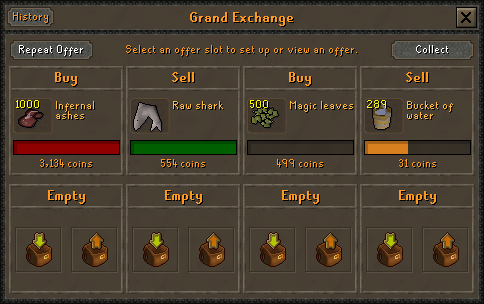
The game does not show trade volume. The live table below the guide shows each item's daily volume for that reason.
| Cheap, high-volume items | Expensive, low-volume items | |
|---|---|---|
| Profit per item | A few coins to a few hundred | Thousands to millions |
| Buy limit | Often in the thousands | Often single or double digits |
| Fill speed | Usually minutes | Can take hours |
| Tax effect | None below 50 gp; some of these items are exempt | Takes a large share of a thin margin |
| Main risk | The margin disappears when many flippers pile in | A price drop while you hold a few expensive units |
Experienced flippers usually follow a few habits. None is a game rule, but they keep losses small while you learn:
- Keep your buy limit a small share of the item's daily volume.
- Raise quantities in steps on a new item, for example 10, then 50, then 250, rather than buying the full limit straight away.
- Spread your coins across several items. Members have 8 offer slots and free-to-play players have 3. Free players can only buy free-to-play items.
How to read the live margins table
The table below this guide is filled from recent Grand Exchange trade data. It shows these values for each item:
- Buy price: the recent instant-sell price. This is roughly where your buy offer fills.
- Sell price: the recent instant-buy price. This is roughly where your sell offer fills.
- Margin after tax: the sell price minus the 2% tax (with the cap and exemptions applied) minus the buy price. This is the profit on one item.
- Buy limit: how many you can buy per 4-hour window.
- Profit per limit: margin after tax × buy limit. This is the most one window can pay if every unit fills at these prices.
- Daily volume: how many units traded in the last day. Compare it with the buy limit.
- Free-to-play or members: whether a free account can buy the item.
Use the table to build a shortlist, then confirm each item before you commit coins:
- Sort by profit per limit to find the items worth a slot.
- Drop any row whose daily volume is not many times its buy limit.
- Be wary of any margin far wider than similar items show. It usually comes from one odd trade or an old price, not a real gap.
- Margin-check the item in game before you buy the full limit. The table shows the last trades it saw, not a promise about your next fill.
Updates, crashes and other risks
Flipping is lower risk than holding items for weeks, but it is never risk-free. These are the usual ways a flip goes wrong:
- Update news. A news post or poll that makes an item more or less useful can move its price within hours. When players expect a price rise, many of them stockpile before the update. The price can then fall on release day as they all sell.
- Buying into a spike. A price that has just jumped has usually finished its move. Buying at the top and hoping is speculation, not flipping.
- Holding a failed flip. If an item falls below your buy price, you have two choices: sell at a small loss, or keep it as an investment you did not plan. Decide which before the loss grows.
- One item, whole bank. A single price drop then hits everything you own, and you have no coins left when a better flip appears.
- Forgotten offers. Unfilled offers pause if you stay logged out for several days. A sell offer left during a break may still be sitting there unfilled while the price moves away.
A routine for your first flips
- Pick three to five items from the table with good profit per limit and high daily volume.
- Margin-check each one in game and work out the after-tax profit per item.
- Place buy offers just above the buy target, sized to a fraction of the limit at first.
- As each buy fills, note the time and place the sell offer just below the sell target.
- Cancel any offer that sits unfilled well past what you expected, then re-check that item.
- Keep a short record of each flip: item, quantity, buy price, sell price and profit after tax. After a few sessions it shows which items are worth your slots.
Active flipping means watching your offers and adjusting prices often, which keeps margins tight and fills fast. Leaving wider offers in place while you train or log off asks for less attention, but prices have more time to move against you. Both approaches use the same arithmetic.
Current flip margins
From the latest instant-buy and instant-sell prices, after the 2% tax, for items trading at least 2,000 a day; "per 4 hours" is the margin times the smaller of the buy limit and a sixth of the daily volume. Updated 2026-11-23T10:27:11Z. Prices move between updates, so check the margin yourself before you buy.
| Item | Buy at | Sell at | Margin after tax | Buy limit | Per 4 hours |
|---|---|---|---|---|---|
 Toad's legs | 300 | 2,594 | 2,243 | 13,000 | 1.53M |
 Ninja impling jar | 40,987 | 43,901 | 2,036 | 18,000 | 1.32M |
 Soiled page | 1,734 | 1,995 | 222 | 11,000 | 1.03M |
 Sapphire dragon bolts (e) | 2,400 | 2,664 | 211 | 11,000 | 879K |
 Ranging potion(3) | 1,644 | 2,107 | 421 | 2,000 | 842K |
 Divine bastion potion(4) | 18,189 | 19,079 | 509 | 2,000 | 832K |
 Magic seed | 64,858 | 69,891 | 3,636 | 200 | 727K |
 Torstol potion (unf) | 3,500 | 3,839 | 263 | 10,000 | 717K |
 Avantoe potion (unf) | 1,868 | 1,990 | 83 | 10,000 | 702K |
 Lantadyme potion (unf) | 1,379 | 1,537 | 128 | 10,000 | 700K |
 Zul-andra teleport | 13,453 | 14,450 | 708 | 10,000 | 693K |
 Onyx dragon bolts (e) | 8,913 | 9,599 | 495 | 11,000 | 678K |
 Lantadyme | 1,217 | 1,299 | 57 | 11,000 | 627K |
 Wyvern bones | 3,594 | 3,846 | 176 | 7,500 | 609K |
 Raw summer pie | 2,606 | 2,850 | 187 | 13,000 | 604K |
 Cooked moonlight antelope | 1,661 | 1,828 | 131 | 6,000 | 578K |
 Hydra bones | 7,550 | 7,959 | 250 | 7,500 | 555K |
 Camphor plank | 2,835 | 2,999 | 105 | 13,000 | 536K |
 Grimy avantoe | 1,567 | 1,650 | 50 | 13,000 | 487K |
 Guam potion (unf) | 570 | 675 | 92 | 10,000 | 470K |
 Wine of Zamorak | 1,082 | 1,144 | 40 | 11,000 | 440K |
 Dragon bolts (unf) | 2,483 | 2,567 | 33 | 13,000 | 429K |
 Dagannoth bones | 12,564 | 13,000 | 176 | 7,500 | 422K |
 Dragonstone dragon bolts | 2,425 | 2,638 | 161 | 11,000 | 414K |
 Manta ray | 1,037 | 1,096 | 38 | 10,000 | 380K |